
'Multiday Wave'
What You Need To Know
You can add my audio features to your favorite podcast app — they will automatically appear once published.
Today’s posts that caught my eye:
Global smartphone shipments fell 11% in the second quarter of 2026 compared to one year earlier — the lowest Q2 results since 2013.
Michigan cases of intestinal disease from parasite soar to over 2,600.
European countries reported more than 10,000 excess deaths during June’s record-breaking heatwave.
The World
The U.S. launched its third consecutive night of strikes on Iran following President Trump’s announcements of a multiday wave of attacks and a fresh blockade on Iranian trade in the Strait of Hormuz. U.S. Central Command said the latest round began at 4:45 p.m. Eastern time to “continue imposing a heavy cost on Iranian forces and degrade their ability to attack innocent civilians and commercial shipping in the Strait of Hormuz.” Trump told radio host Hugh Hewitt that the U.S. was going to hit Iran “very hard” Monday and Tuesday, “and there’s not a damn thing they can do about it.” Speaking shortly before Monday’s attacks began, Trump further announced that the U.S. would strike Pickaxe Mountain, a fortified, underground nuclear site yet to be targeted since the war began Feb. 28. (Wall Street Journal)
Trump demanded a 20% reimbursement on cargo shipped through the Strait of Hormuz, which would be roughly $30 million on full supertankers carrying oil based on current oil prices. Iran had been charging as much as $2 million per voyage on an adhoc basis, according to people familiar with the matter. Iranian Foreign Minister Abbas Araghchi said that whoever provides secure passage should be compensated, but stated that “20% is of course too much” and added “We will be fair”. (Bloomberg)
President Trump gave Saudi Crown Prince Mohammed Bin Salman (MBS) his support for a highly unusual military action against the Iran-backed Houthis in Yemen, according to two U.S. officials. The Saudi strike on the Sanaa airport Monday and Houthi retaliatory missile attacks that followed were the most serious cross-border escalation since 2022. They could signal the collapse of a four-year, unofficial truce between the parties. A renewed military conflict between Saudi Arabia and the Houthis could exacerbate regional tensions and broaden the war between the U.S. and Iran. The fact that MBS notified Trump in advance and asked for his backing signals that the Saudis are concerned about a larger conflict with the Houthis that will require military and diplomatic support from the U.S. (Axios)
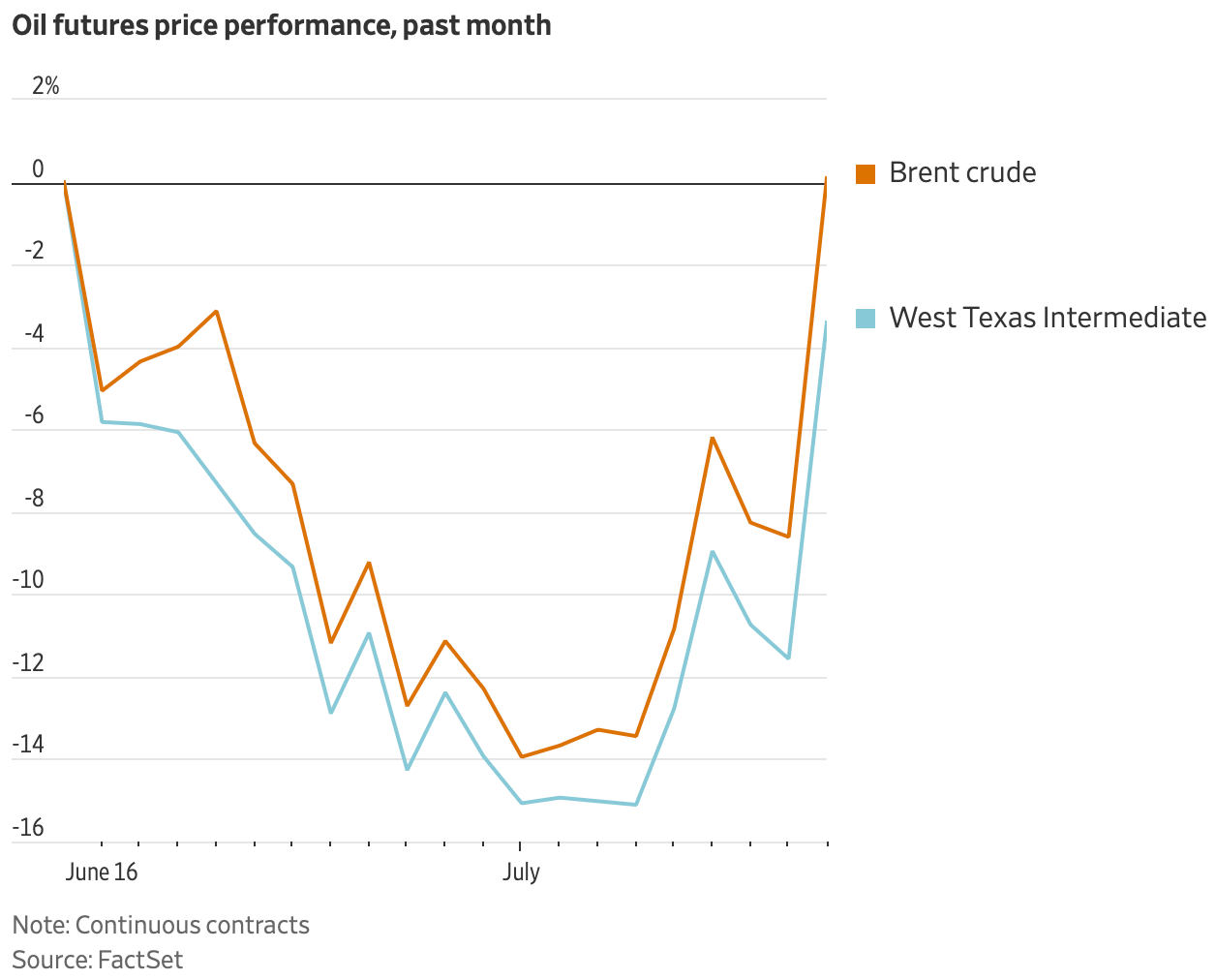
Oil Surges Most Since 2020, Reflecting Bet That Strait Won’t Go Back to Normal. (Wall Street Journal)
Secretary of State Marco Rubio vowed to “dismantle” the International Criminal Court and “urged other countries to join the effort as the Trump administration significantly escalates its campaign against the global institution. Rubio accused the ICC of ‘waging a war against our country, not with bullets or missiles,’ but with ‘the force of so-called international law.’” The Trump administration “has imposed a slew of sanctions against ICC officials for their attempts to investigate the U.S. and Israel,” but the “State Department-led, ‘whole-of-government campaign’ to dismantle the ICC is a significant escalation.” (CNN)
Netanyahu opponent leads polls ahead of Israeli elections: Israel’s centrist former military chief Gadi Eisenkot has overtaken Prime Minister Benjamin Netanyahu in several opinion polls as Israel announced that it has set a date for general elections in October. Parliament is set to dissolve on Friday after formally selecting October 27 as election day, the latest date mandated by law — bringing a close to what was by many measures the most tumultuous four-year term for any government in Israeli history. The latest poll from public broadcaster Kan showed Yashar inching ahead of Likud by one seat — 24 to 23 — in Israel’s 120-seat parliament, echoing a similar survey by Channel 13 aired last week. In the Kan poll, Eisenkot led Netanyahu by 41 per cent to 37 per cent among respondents when asked who would be better suited to serve as prime minister. (Financial Times)
Israel passes quasi-constitutional law declaring Torah study a foundational value: Defying outcry from legal officials, the IDF, reservists and opposition parties, coalition secures final approval of flagship Basic Law, which aims to enable ongoing broad exemption of ultra-Orthodox young men from IDF service. (Times of Israel)
The Gaza Strip will receive about €900 million in donations from Europe “after an EU-backed conference raised the funds for the reconstruction of the embattled enclave.” The funding “will first go to providing the Palestinian territory with basic water and sanitation facilities, as well as restoring the Gaza Strip’s health and food systems hit hard by the war with Israel.” (DW)
French President Emmanuel Macron said that France “has fulfilled its ‘commitment to rearm’ during his annual speech to the military services.” The increase in defense budgets since Macron took office in 2017 “with a focus on France’s ‘rearmament’ is a ‘commitment that has been fulfilled,’ the president stated Monday in his traditional address to the armed forces,” his last before leaving office. (France 24)
Venezuela’s interim government is signaling that elections “have taken a back seat to the country’s massive reconstruction effort, dismissing questions about electoral preparations as inappropriate while officials struggle to respond to the devastating earthquakes that have now claimed 4,490 lives.” National Assembly President Jorge Rodríguez said that the government is focused entirely on responding to the humanitarian crisis. He said, “It is disrespectful, it is rude, to be meeting as politicians deciding who goes to the National Electoral Council or who goes to the Supreme Court. There will be time for that.” (Miami Herald)
Economy
Federal Reserve Governor Christopher Waller expressed concern about inflation “but cautioned against ‘fighting the last war,’ saying the central bank should wait for more data before raising interest rates.” Waller said in a New York speech that inflation “has expanded beyond the often-cited drivers such as the energy price spike in tariffs. Rather, he cited other factors, particularly artificial intelligence, as root causes” for why prices have remained high. (CNBC)
Boston tops FT-Nikkei ranking as global companies seek skilled workers: Boston has been named the best US city for foreign multinationals to do business, topping the fourth annual FT-Nikkei Investing in America ranking as companies prioritise skilled workers and research networks despite the city’s higher costs. The rankings measure American cities across more than three dozen metrics important to foreign investors, and Boston represents a new kind of winner, driven by human and intellectual capital, rather than cheap land and low taxes. Its reliable power grid and strong public transit network helped the capital of Massachusetts fare better than previous winners in Florida and Texas in a new energy resiliency category. (Financial Times)
Boston leads list of best US places for foreign businesses in FT-Nikkei ranking: Massachusetts capital pulls ahead of previous winner Tampa on skilled workforce and rising investment. (Financial Times)
Goldman Sachs is pitching a trade that would allow large investors to buy back capital call lines to their own funds, freeing up balance sheet capacity for the bank. The trade would allow limited partners to receive interest on capital that would otherwise be sitting idle, with current interest rates at about 160 to 210 basis points over the benchmark. The move is part of a series of financial innovations in private markets, seeking to boost returns, use capital more efficiently, and make up for a dearth of investment exits. (Bloomberg)
South African Reserve Bank Governor Lesetja Kganyago expects inflation to recede to the desired three percent benchmark “a bit faster” than previously anticipated. Kganyago said that “falling global oil prices are on course to lower South Africa’s inflation rate,” prompting economists “to scale back expectations of back-to-back interest rate hikes.” (Semafor)
Stellantis said that preliminary second-quarter vehicle shipments rose 10% from the same period last year “to nearly 1.6 million units, driven by strong growth in North America, its most important market. Reviving sales is central to CEO Antonio Filosa’s turnaround plan for the automaker, which has seen customer defections in key markets in recent years due to higher vehicle prices, a heavy focus on electric vehicles, quality issues and growing competition from Chinese manufacturers.” (Reuters)
Technology
‘Christ almighty, this is so bad’: ChatGPT’s big app update brings huge changes to your workflows — and users seem to hate it. Unfortunately for OpenAI, this major change has not gone down too well. Apple pundit John Gruber, for example — long a fan of OpenAI’s decision to make ChatGPT a native Mac app that conformed to macOS conventions — described the change as “the day OpenAI f*cked up the ChatGPT Mac app.” He also pointed out that while the old ChatGPT app weighed in at a lightweight 159MB, the new edition has ballooned to 1.5GB. (Tech Radar)
European Commission President Ursula von der Leyen has called for limits to be placed on children’s use of social media “as a special EU panel looking into the challenge recommended forbidding access for those under 13 until tech companies can prove their platforms are safe.” Von der Leyen, who is a doctor, “said that children under 3 should have no exposure to screens at all.” (Associated Press)
Twelve states including California and New York “challenged Paramount’s takeover of Warner Bros. Discovery on Monday, filing a lawsuit that argues the $81 billion mega merger would “extinguish competition” in Hollywood and threaten jobs across the industry.” The office of California’s attorney general, who is leading the case, “said the states are asking Warner and Paramount to not close their merger ‘until after the judicial process concludes’ — and if the companies do not agree, the coalition will then file a temporary restraining order.” (Associated Press)
TikTok and YouTube are reinventing sports viewership. Broadcasters are taking note. The NBA Finals just scored some of its biggest viewership numbers in decades, on both TV and social media, according to the league. Leagues and rights holders are increasingly using social media as a platform to reach Generations Z and Alpha to capture a younger audience that is less likely to turn on the TV. The rise of sports content on platforms like TikTok and YouTube has left broadcasters with a dilemma of whether to fuel the funnel or protect their subscription revenue. (CNBC)
California Gov. Gavin Newsom (D) has signed legislation creating state rebates of $3,500 on new electric vehicles for first-time buyers. The $270 million rebate program “is funded by the state budget and automakers. It applies to new vehicles with a suggested retail price of up to $50,000. It also includes a separate $1,750 rebate for used EVs costing up to $25,000.” (Reuters)
Smart Links
Court Revives Lawsuits Tying Tylenol Use in Pregnancy to Autism and A.D.H.D. (New York Times)
The Quarter-Trillion-Dollar Onslaught of AI Bonds Is Testing Investors’ Limits (Wall Street Journal)
With AI character Tilly Norwood set for feature-film debut, Hollywood debates what it means to be an actor (Los Angeles Times)
Mexican food chain Chipotle takes its burritos and bowls to Mexico. (Financial Times)
Sweet! Sugar found in raspberries was discovered near the Milky Way’s center, hinting that life’s ingredients are common in space (LiveScience)
World Cup fans flock to In-N-Out, Erewhon and Trader Joe’s for a taste of California. (Los Angeles Times)
Good News
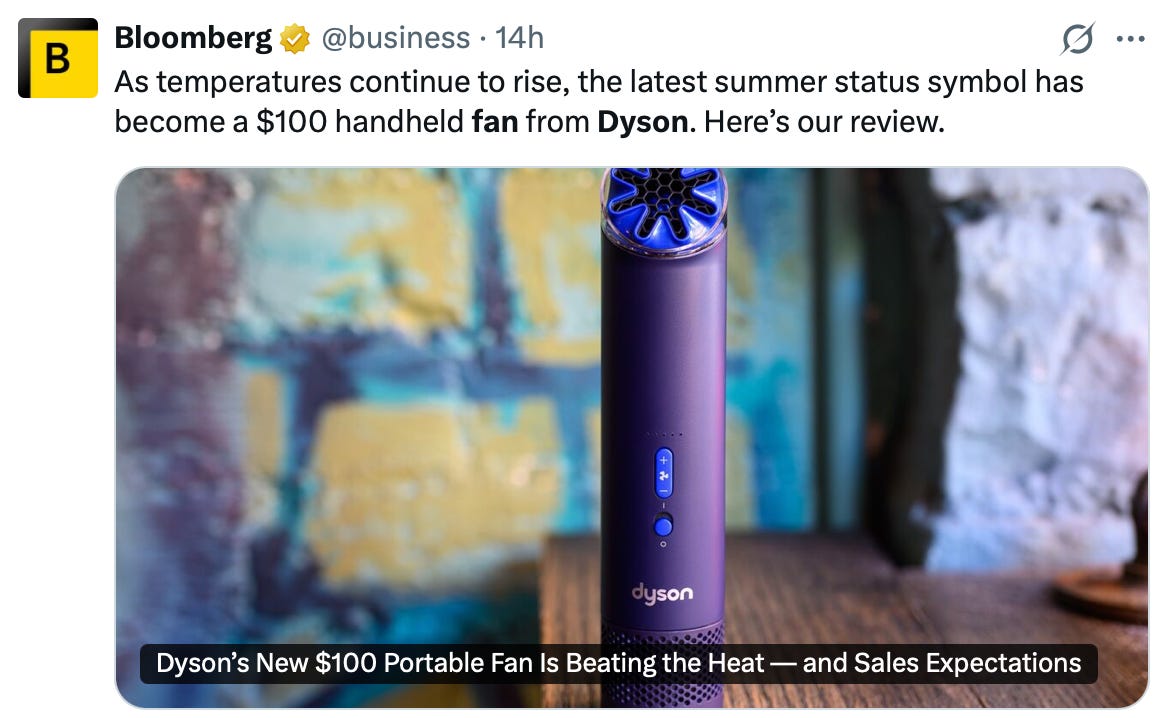
Dyson’s New $100 Portable Fan Is Beating the Heat — and Sales Expectations: Dyson Ltd. has been unable to keep its $100 HushJet Mini Cool portable fan in stock since it debuted in April, citing high temperatures. The company says the consumer reception has been incredible and exceeded expectations, with demand especially high as temperatures rise. (Bloomberg)
Saturdays in a Frisco, Texas, neighborhood feature long lines of customers waiting for Angela Henson’s “Little Bit Bakery.” Operating from home under the state’s Cottage Food Law, Henson wakes up around “2:30 in the morning” to prepare fresh sourdough. Fueled by social media, her porch-cart bakery is so popular that eager customers arrive hours before opening to avoid leaving empty-handed. Regulars insist her “phenomenal” goods are “well worth the wait.” (KXAS)
Thank you for reading my newsletter. Don’t forget to add the audio version of this Newsletter — plus other audio features — to your favorite podcast player.